

Short answer: rinse your aligners every time you take them out, brush gently with a soft brush and clear antibacterial soap (not toothpaste, it's abrasive enough to scratch and cloud the plastic), never use hot water or bleach, and soak them properly a few times a week. Invisalign sells its own Cleaning Crystals for this; a persulfate free liquid cleaner works the same job, costs less over time, and doesn't need a fresh sachet every soak.
The entire point was that nobody could tell
That's the whole pitch of clear aligners: invisible, or close enough. Which makes it a genuinely strange own-goal to clean them with something abrasive enough to leave them cloudy, scratched, or faintly yellow by week three. At that point you haven't got an invisible aligner. You've got a visible one that used to be invisible, which is arguably worse.
Toothpaste is the usual culprit. It's formulated to be mildly abrasive on enamel, and enamel is far tougher than clear aligner plastic, so the same scrub that's fine for your teeth is quietly sanding down the one feature you paid extra for.
What actually clouds the plastic
- Toothpaste. Scratches the surface at a microscopic level. Each scratch catches light slightly differently, and enough of them add up to visible cloudiness.
- Hot water. Clear aligner plastic can warp under heat, same as a retainer or mouthguard. Never run it under a hot tap or through the dishwasher.
- Bleach and harsh household cleaners. Not formulated for a material that sits against your gums for 20+ hours a day; skip anything from under the kitchen sink entirely.
- Coloured or scented soap. Dyes can leach into the plastic over repeated use. Clear, unscented antibacterial soap is the safer daily choice.

The routine that keeps them actually invisible
- Rinse immediately on removal. Cool or lukewarm water, every single time, before anything has a chance to dry onto the surface.
- Brush gently with clear soap. A soft brush, never toothpaste.
- Soak properly, a few times a week. A rinse removes what's loose; a proper soak reaches what's actually attached.
- Store dry, never damp. A case that stays wet all day undoes the soak you just did.
Where a liquid cleaner fits in
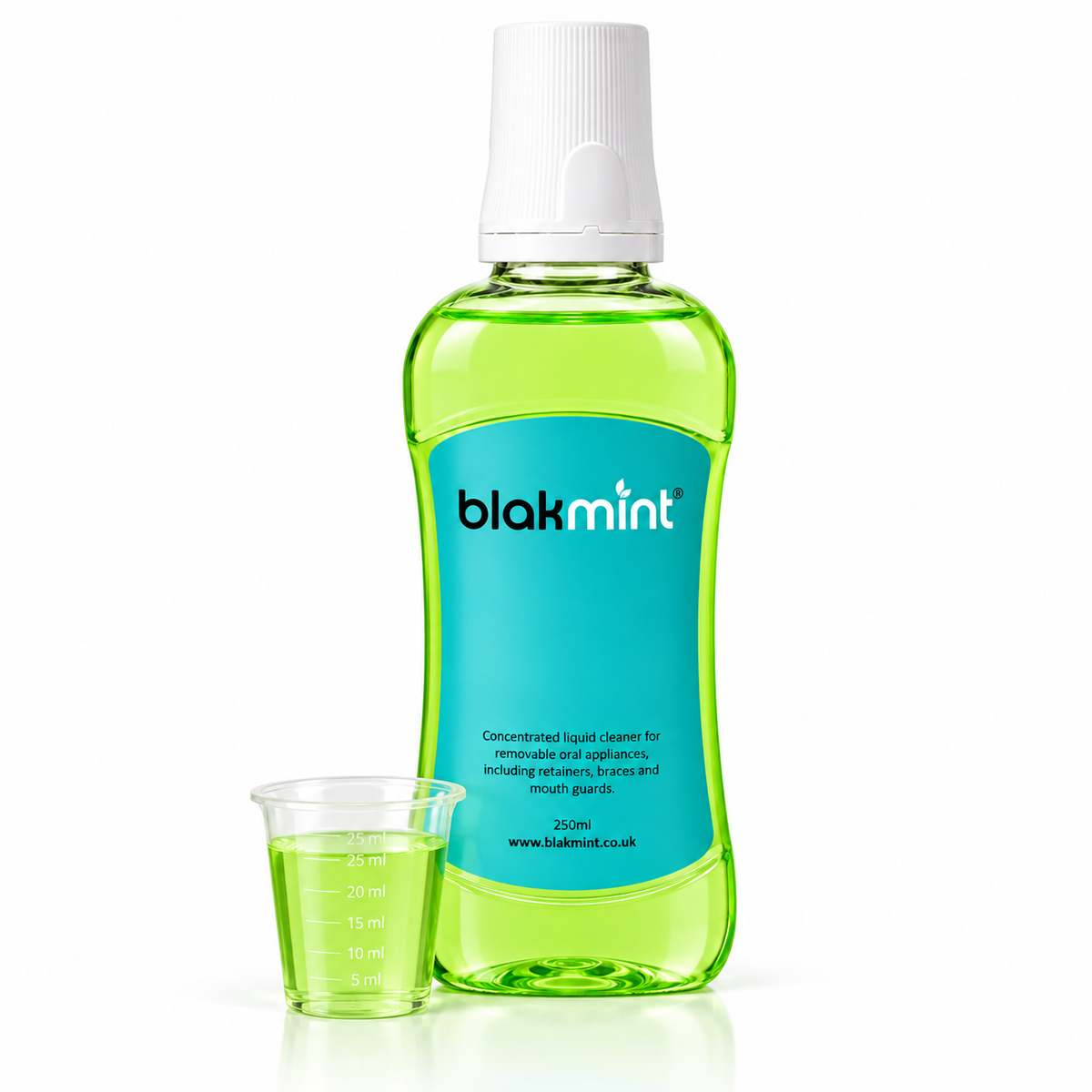
Invisalign's own Cleaning Crystals dissolve in water to loosen plaque and bacteria from the tray surface, a tablet-format product, used daily, bought again when the pack runs out. Blakmint's liquid cleaner does the same core job, differently: it was tested under ASTM E2315, the lab standard for measuring bacterial reduction on an appliance surface, against a mixed inoculum of four real bacteria strains, Pseudomonas aeruginosa, E coli, Staphylococcus aureus and E hirae, with a 99.99% reduction at a 20-minute soak.
It's persulfate free, which most mainstream cleaning tablets aren't (persulfate is a named allergen on several tablet brands' own packaging), and a 250ml bottle at £14 is reused across 6-day batches rather than needing a new sachet every soak.

When it's not a cleaning problem
- A tray that's gone visibly cloudy despite careful cleaning. Some surface wear is normal by the end of a tray's 1 to 2 week rotation; it's being swapped out anyway.
- A tray that's cracked or split. Contact your orthodontist for a replacement rather than trying to clean around it.
- Persistent bad breath despite a clean routine. Worth mentioning at your next check-up rather than cleaning harder.
Frequently asked
-
Can I use mouthwash to clean Invisalign trays?
Not ideally. The alcohol and colouring in most mouthwash can dry out the plastic and contribute to discolouration over repeated use. -
Is it safe to use the same cleaner across multiple aligner trays in rotation?
Yes, as long as you're using a fresh soak each time rather than the same solution across several trays. Cross-use between trays just moves bacteria around rather than removing it. -
Why do my aligners smell by the end of each 1 to 2 week swap?
Normal daily wear and saliva exposure. The routine above (rinse, brush, soak a few times a week) keeps it from building up, but some smell by the end of a rotation is expected. -
Do I need a special cleaner, or will any denture cleaner do?
Most dedicated aligner, retainer and denture cleaners use similar formulations. Check the label states it's safe for clear plastic/aligner material specifically.
The Blakmint liquid cleaner is £14 for up to 5 months of use, persulfate free, ultrasonic-safe, and works on clear aligner trays, retainers, dentures and mouthguards alike.
Wear a retainer after your aligner treatment finishes? Read How to Clean Retainers for the wire-vs-clear breakdown. Just finished treatment and wearing Vivera retainers? See Vivera Retainer Care: How to Clean and Look After Yours.